
Sioux County, Crawford consider activities co-op, again
By Kerri Rempp
Sioux County Schools PIO
Sioux County and Crawford will vote on a proposed cooperative activities program in April, and ahead of the districts’ board meetings, public input sessions were held in the community last week.
The current proposal includes junior high and high school sports, as well as speech, one-act play and cheer. The inclusion of FFA is still being discussed. Due to the two-year scheduling cycle for football by the Nebraska School Activities Association, football is not currently on the table, but the proposal was drafted with the inclusion of the sport in the future.
“The students benefit. That’s our number one goal,” said Crawford Superintendent Keri Homan.
Sioux County did not have varsity volleyball this year, nor did it have boys’ or girls’ basketball. Crawford is faced with not having boys’ basketball this winter.
Comments were generally positive during the session in Harrison.
Jessi Grote recalled going from a 2-19 team as a freshman to a cooperative sports program her final three years in high school.
“It was hard, but it gave me so many opportunities. I had to compete. I wasn’t given my spot, but it was so fun,” she said, adding that she built relationships for a lifetime, and their team made regionals three consecutive years. In small towns, she added, kids sometimes are spread thin because there is a need for them to do everything to make a team. A cooperative program may allow kids to truly flourish in activities they are passionate about rather than overextending themselves for ones in which they have less interest.
“I do think it’s a benefit to the kids,” she said.
“Unity is possible, and it is something I believe both communities can find together. Give kids the opportunity and allow administrators to make level-headed decisions,” said Stacie Holmgren.
Crawford’s Sam Dyer reminded everyone that there will be things that need to be adjusted along the way as the districts move through the process but that can be dealt with.
“Adults need to put everything aside and remember we’re doing this for the kids. It doesn’t matter where Judd Skavdahl graduated or where Sam Dyer graduated. We might not be the Crawford Rams. Who cares? If they actually play, that’s all that matters,” she said. “It shouldn’t be about who has more concessions or fundraisers. We can either make an opportunity or not have it at all. We need to come together and be a united front.”
Chadron School Board President Boone Huffman, who recently enrolled a student at Crawford, also spoke in support of the cooperative proposal, saying the reality is that rural areas are facing declining populations. He shared that his wife was against the cooperative agreement between Sandhills and Thedford, her alma mater. Years later, despite fears that one of the schools would close after combining sports programs, they are both still open, and they just went and cheered them on in a state championship contest.
“No one there was saying ‘Thedford’ or ‘Dunning.’ They were the Knights,” Huffman said. “A lot of the problems in the beginning were the parents. The kids got along great. It is up to us as families and communities to take care of each other.”
The only comment expressly against the proposal came from Rod Gray, who said a cooperative sports program is the first step to losing the school in Sioux County.
This is not the first time the districts have considered a co-op. In 2022, Sioux County students played with Crawford for girls’ basketball and boys’ golf, but a continuation of the basketball option was voted down by Sioux County in 2024. Last fall, Sioux County approved a sports cooperative, but the matter died in Crawford.
Superintendents, athletic directors and a contingent of board members from each district resumed conversations in January as both programs face declining enrollment and smaller or non-existent sports teams.
“There are some years where we are not going to have enough kids,” said Homan.
“We both need each other to field those successful teams,” added Sioux County Superintendent Liz Baker. “There are years we won’t field successful teams or we won’t field a team at all.”
The committee presented a draft handbook for the proposed program, which calls for continued oversight from a cooperative advisory committee that will meet three times a year and provide recommendations to the school boards. The handbook also spells out chain of command for coaches and for student-athletes and parents.
Under the proposal, current coaches at both schools who wish to continue coaching will be allowed to do so. Should coaches resign, the athletic directors will determine if the vacancy needs to be filled. Coaches will be paid based on whichever district has the highest base salary.
The two districts will share the cost of the cooperative equally through a cooperative account that will hold revenues and pay expenses. Facilities at each site will be maintained and improved at the sole discretion of each school, however. For example, basketball floors would be replaced by each individual school on their own schedule, Homan said.
Another area still up for discussion is admission costs to games or passes. Baker noted that Sioux County currently does not charge admission, so the districts are still working to find ways to address the issue.
The proposal calls for the number of high school practices and games to be split as evenly as possible based on a number of parameters, including how many students from each school are involved in an activity, scheduling conflicts at each facility, opponent and the type of contest and expected crowd. Junior high will practice at their home districts two to three times a week and practice jointly at least once a week. Transportation to practices and games will be organized by the schools.
District officials from both schools stressed that students will not be punished for missing practice due to bad weather and said there will be coordination in the event of winter storms. In those circumstances, all practices could be canceled or student-athletes could practice in their home districts based on localized weather conditions.
“We’re not going to put kids out on the roads if we know it’s not good,” Homan said.
During the public input session in Harrison, specific questions and comments focused primarily on transportation and the practice and game split.
Sioux County parents expressed concern that Crawford would host almost all practices and games if things like location opponent and the number of students from each school were used in determining the split. Baker said the districts are committed to splitting the practices and games in the best way that makes sense for both communities, noting that the split may vary some season to season. Swisher emphasized that opponent location is not the only factor that will determine where a game is played, adding that many of the teams located in the southern Panhandle could just as easily play in Harrison.
Pat Andersen and Naomi Pelster both implored the districts to do a true 50-50 split of practices and games to meet the mission statement’s declaration of an “equally accessible” program. Pelster said for the effort to be successful there needs to be unity, and without a 50-50 split for each activity it feels like it won’t work.
“If we’re going to do it, we need it to be successful,” she said.
One submitted question also feared that decreasing the number of overall games at each district would negatively impact fundraising opportunities for students to raise money for things like prom. Baker admitted that could be an issue but believes that other opportunities could evolve over time to offset the concern.
Patrons also questioned whether the schools would have to move up a class, and if so, which schools would be scheduled, concerned over increased travel for games. Sioux County Principal Barry Swisher noted that based on numbers today the cooperative program would play many of the same teams they already do, and the highest class it would be assigned to is D1.
“It would still be in this area of the state,” Swisher said.
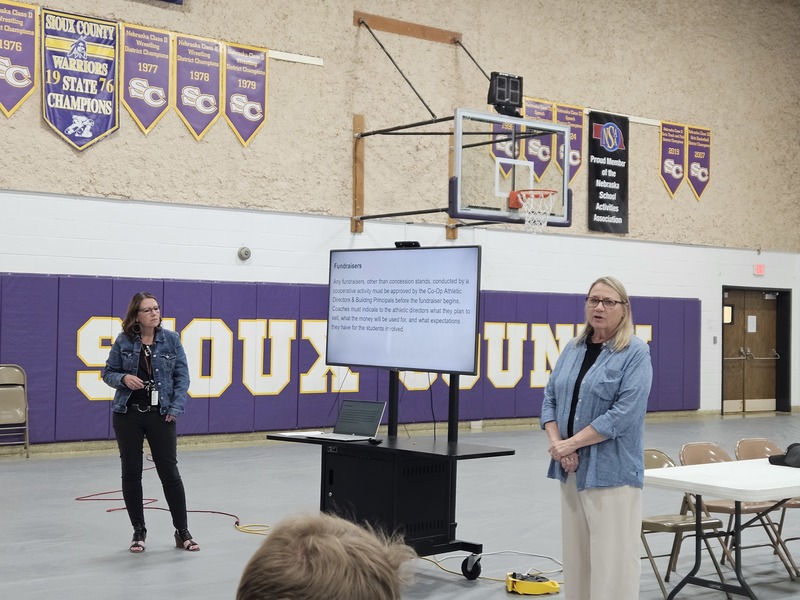 Crawford and Sioux County Superintendents Keri Homan and Liz Baker, from left, review the draft proposal for a cooperative agreement for sports and extracurricular activities with members of the public. Photo by Kerri Rempp, Sioux County Schools PIO